
A website may look professional while still leaving important questions unanswered. Before creating an account, users should know who operates the service, what personal information is required, which companies receive that information, and what happens to the data after the account is closed.
Checking only the privacy policy or only the company information is not enough. A more reliable approach is to compare the operator information, registration screen, privacy policy, and payment process as one connected set.
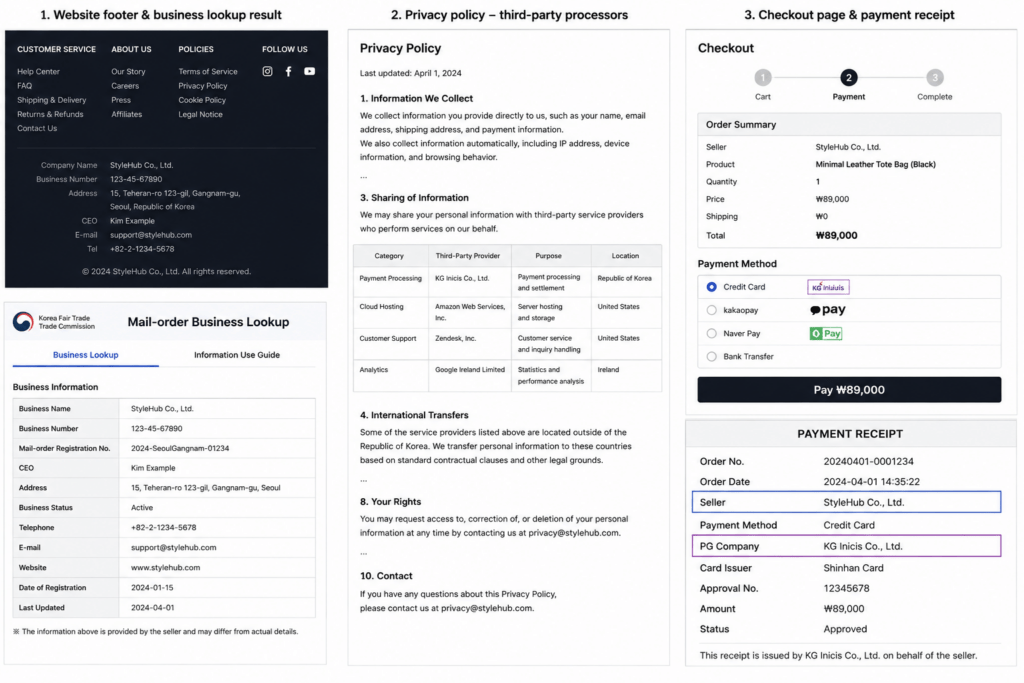
Website Operator Information
Start with the company information shown in the terms, footer, business information page, or customer-service section. For Korean online businesses, the Electronic Commerce Act requires cyber-mall operators to make information such as the business name and representative, business address, telephone number, email address, business registration number, and terms of use available to consumers.
The brand name does not necessarily have to match the legal corporate name. A service may operate under a consumer-facing brand while another legal entity owns or operates the website. What matters is whether the relationship can be clearly explained.
Check the corporate name, business address, jurisdiction, contact information, and personal-information inquiry contact. If the operator’s information appears only inside an image, is difficult to locate, or is mixed with another unrelated company name, record the inconsistency before registering.
For Korean businesses, registration information can also be compared with official business records. A mismatch does not automatically mean that the website is fraudulent, because companies may change addresses, brands, or operating structures. However, an unexplained mismatch is a reasonable reason to pause and investigate further.
Required and Optional Personal Information
The registration screen should be compared directly with the privacy policy.
Check whether the website actually needs information such as:
- Name
- Date of birth
- Email address
- Telephone number
- Address
- Location information
- Identification information
The important question is not simply whether information is collected, but why it is required for the service.
Separate information that is necessary to create or operate the account from optional information used for advertising, personalization, analytics, or other additional functions. Also record what happens when optional consent is refused. If declining optional consent prevents the user from accessing a basic service, that restriction should be clearly explained.
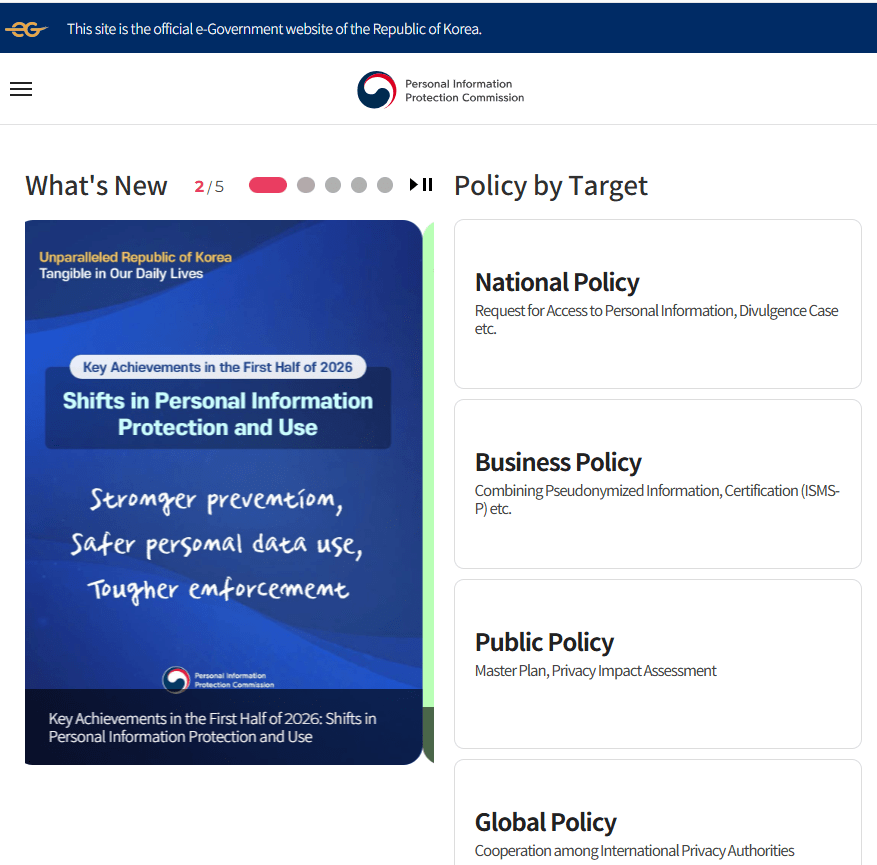
The Personal Information Protection Commission’s current 2026 privacy-policy guidance is intended to help organizations disclose their personal-information processing practices transparently and consistently with the Personal Information Protection Act.
A useful practical check is to compare every field on the registration screen with the corresponding privacy-policy section. If the registration form requests information that is not explained in the policy, save a screenshot and record the difference before continuing.
Pre-selected consent boxes and difficult-to-find withdrawal procedures should also be recorded. The purpose is not to assume that every unusual interface is illegal, but to preserve evidence of what the user actually saw when consent was requested.
Payment Processor Data
Payment processing creates another layer of information sharing.
The website operator, seller, payment gateway, card company, and fraud-prevention service may all have different roles. Therefore, their names do not necessarily need to be identical.
Before entering payment information, check the domain of the payment window and determine whether card information is processed directly by the website or transferred to an external payment company.
Also check what additional information may accompany the payment transaction. Depending on the service, this can include:
- Purchased product or service
- Order number
- Email address
- Customer information
- Device or transaction identifiers
- Fraud-prevention information
The key question is whether the payment processor’s role is identifiable and whether the information transferred is explained in the relevant privacy documentation.
A different payment-company name is not automatically a warning sign. A payment gateway can legitimately process transactions on behalf of a seller. The important issue is whether the relationship among the website, seller, payment processor, and final transaction record is understandable.
Third-Party Provision and Data Processing
Privacy policies often mention outside companies under broad categories such as affiliates, partners, or service providers. Users should look beyond these general descriptions.
There is an important practical difference between third-party provision and processing entrusted to another company.
For third-party provision, check the recipient, purpose, information provided, and retention period. Korean law specifies information that must be communicated when consent is used as the basis for third-party provision, including the recipient, purpose, data items, retention period, and the right to refuse consent and related disadvantages.
For entrusted processing, check what work is being outsourced and which company performs it. The Personal Information Protection Act requires the outsourcing arrangement to address matters such as restrictions on processing outside the entrusted purpose and security measures, and requires the entrusted work and processor to be publicly identifiable.
This distinction is useful when reviewing companies involved in advertising, analytics, delivery, customer support, identity verification, cloud services, and payment processing.
A generic statement such as “information may be shared with affiliates and partners” provides less practical information than a clear explanation of which company receives which information, for what purpose, and for how long.
Retention After Account Withdrawal
Deleting an account does not necessarily mean that every record disappears immediately.
Before registering, check the retention section of the privacy policy and identify what happens after withdrawal. Separate ordinary profile information from records that may need to remain for legal, accounting, payment, or dispute-related reasons.
For example, a website may delete or anonymize ordinary account information after withdrawal while retaining certain transaction records for a legally required period. These categories should not be treated as if they have the same retention period.
Check specifically:
- Account and profile information
- Payment records
- Order history
- Refund records
- Access or security logs
- Customer-service records
- Legal or dispute-related records
The important point is to determine which information remains, why it remains, and when it is scheduled for deletion.
If the policy simply states that information will be “deleted after withdrawal” while another section says transaction or legal records are retained, record the different categories rather than assuming that the entire account disappears at once.

Privacy Policy and Sign-Up Screen Consistency
The final check is consistency between what the policy says and what the user actually encounters.
Compare the privacy policy with the registration screen field by field. Pay particular attention to information described as optional but presented as mandatory, consent boxes that are already selected, and functions that appear unavailable unless additional consent is provided.
Keep a simple record:
| Check | Information |
|---|---|
| Registration field | Information requested on screen |
| Policy status | Required or optional |
| Purpose | Reason for collection |
| Recipient | Company receiving the data |
| Retention | Period or deletion condition |
| Consent | Required, optional, or unclear |
| Screen evidence | Screenshot or recorded path |
This creates a more reliable record than reading the privacy policy alone.
Registration Verification Checklist
Before registering on an unfamiliar website, confirm the following:
- Operator: legal company name, representative, address, jurisdiction, and privacy contact.
- Collection: required information, optional information, collection purpose, and consequences of refusing optional consent.
- Payment: payment-window domain, seller, processor, information transferred, and transaction records.
- External companies: third-party recipients, entrusted processors, purposes, and retention periods.
- Withdrawal: deleted information, retained records, legal retention periods, and deletion conditions.
- Interface: consistency between the privacy policy and the actual registration screen, including pre-selected consent and withdrawal options.
The safest approach is not to expect every company name to be identical. A legitimate service can have separate entities for operation, payment, delivery, analytics, and customer support. What matters is whether those relationships are transparent, explainable, and consistent with the information shown to the user.
When the operator cannot be identified, required information is unexplained, payment data is sent to an unclear domain, or the registration screen contradicts the privacy policy, pause before providing personal or financial information. A clear evidence trail allows users to make a registration decision based on the actual service structure rather than its appearance.