
Living as an expatriate or international professional requires navigating a complex financial web. When your life spans across borders, keeping your money accessible, secure, and tax-compliant can quickly become overwhelming.
Instead of asking whether local accounts or international accounts are “better,” long-term residents must look at how money flows into and out of their daily lives. The right setup depends on where your income originates, where your primary bill payments happen, and what administrative hurdles you will face when you eventually move again.
Income source and daily expenses: Finding your ideal banking structure
Your primary banking setup should be built directly around your cash flow pattern. Most expatriates and long-term residents in Korea fall into one of two primary financial scenarios:
Scenario A: Local salary with overseas financial obligations
If you are employed by a Korean company or university, your salary arrives in KRW at a domestic bank like Hana Bank or Shinhan Bank. You need this local account to pay rent, setup utilities, and use local payment apps. However, if you still have student loans, mortgages, or family support obligations in your home country, relying solely on your Korean bank for monthly international wires will result in significant financial leakage over time.
Scenario B: Overseas income spent in the local economy
If you work remotely for a foreign company, receive an overseas pension, or freelancing income in USD or EUR while living in Korea, your main challenge is local liquidity. Converting large lump sums through traditional wire transfers to a Korean account incurs heavy foreign exchange spreads. In this case, maintaining a multi-currency international account acts as a buffer before money touches the local banking system.
The real cost of moving money: Foreign exchange markups versus wire fees
Many long-term residents assume that a bank advertising “zero wire fees” is giving them a good deal. In cross-border banking, flat transaction fees are only a small fraction of the total cost.
Decoding the foreign exchange spread
Traditional commercial banks in Korea generate profit on international transfers primarily through the foreign exchange (FX) spread – the difference between the mid-market exchange rate and the rate offered to retail customers. A standard Korean bank might charge a 1% to 2% markup on currency conversion. On a monthly transfer of $3,000, a 1.5% hidden markup costs you $45 every single month, far exceeding any $10 flat wire fee.
The FinTech alternative
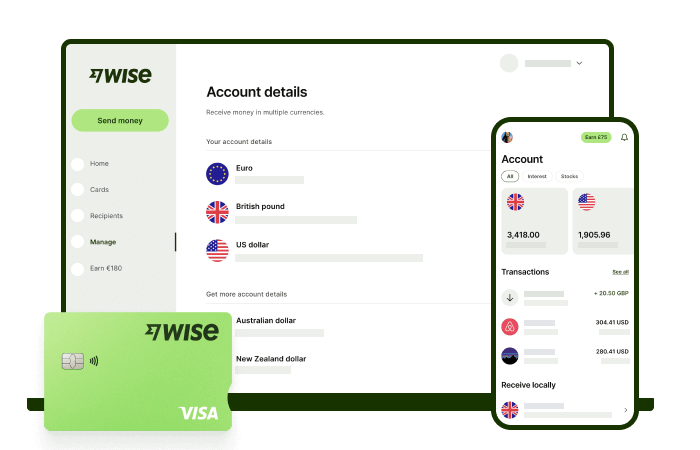
Specialized international accounts like Wise and Korean remittance services like Sentbe process transfers using mid-market exchange rates with transparent, low upfront service fees. Over a multi-year stay in Korea, routing your international transfers through these specialized channels can save thousands of dollars compared to traditional bank-to-bank wires.
The departure nightmare: How ARC expiration locks Korean local banking
One of the most critical factors long-term residents overlook is what happens to their bank accounts when their residency status changes.
In Korea, local bank accounts are strictly bound to your Alien Registration Card (ARC – 외국인등록증) and your registered local mobile phone number. To perform online banking transfers, Korean banks require mandatory identity verification (본인인증) sent via SMS to your active Korean SIM card.
If you leave Korea permanently, your ARC expires, and your Korean phone plan is canceled. The moment your Korean phone number is deactivated, you lose the ability to perform online banking transfers. If you leave remaining funds in a Korean bank account after departing, accessing or transferring that money from abroad becomes a legal and administrative nightmare requiring embassy paperwork or physical power of attorney.
International multi-currency accounts like Wise or Revolut solve this problem entirely. Because they accept legal residential addresses from multiple countries, you can update your physical location in the app after moving without losing access to your money or multi-currency balances.
Cross-border tax reporting checklist for residents in Korea
Holding financial accounts across borders creates legal obligations that cannot be ignored. Financial institutions automatically share customer data internationally under global transparency agreements.
- Korean NTS reporting (500 million KRW limit): If you are a tax resident in Korea, you must report all foreign financial accounts to the National Tax Service (NTS – 국세청) if your combined foreign account balances exceed 500 million KRW on the last day of any month during the year.
- US citizens and FBAR compliance ($10,000 limit): US expats living in Korea must file an FBAR (FinCEN Form 114) annually if the aggregate value of all their Korean bank accounts exceeds $10,000 at any point during the calendar year.
- Automatic information exchange (CRS): Over 100 countries participate in the Common Reporting Standard (CRS). Korean banks and international account providers automatically report your account balances to the tax authority of your country of tax residence.
Account selection cheat sheet: Summary of features and recommendations
To help you decide on your banking architecture, use this summary reference guide based on your long-term plans:
| Feature / Criteria | Korean local bank (Hana / Shinhan) | International account (Wise / Revolut) | Korean FinTech (Sentbe) |
| Primary purpose | Local salary, rent, utilities | Long-term global savings buffer | Fast cross-border remittance |
| FX fee cost | High (1-2% exchange markup) | Very low (mid-market rate) | Low (transparent low fee) |
| Post-departure usability | Poor (locks without Korean phone) | Excellent (accepts global address) | Poor (requires active ARC) |
| Best overall strategy | Keep for local living expenses | Keep as central wealth hub | Use as remittance bridge |
Final recommendation: Do not choose between local and international accounts. The safest strategy for long-term expats in Korea is a hybrid model: use a local bank for daily living expenses, route international transfers through specialized services like Sentbe or Wise, and store your long-term savings in a multi-currency international account that moves with you wherever you live next.