Choosing a platform for translated Korean webtoons or web novels is not simply a matter of finding the service with the most titles. A large catalog has limited value when the translations are difficult to follow, favorite series update irregularly, or most available stories fall outside the reader’s preferred genres.
It is also misleading to assume that webtoons always have better translations or that web novels always release chapters faster. Quality and release speed vary by title, localization team, publisher, licensing agreement, and season schedule.
A more useful comparison asks three questions: Is the translation consistent? Does the series follow its announced release schedule? Does the platform carry enough stories the reader genuinely wants?
Test Translation Quality With Actual Chapters
Translation quality should be evaluated at the title level rather than through the reputation of the entire platform.
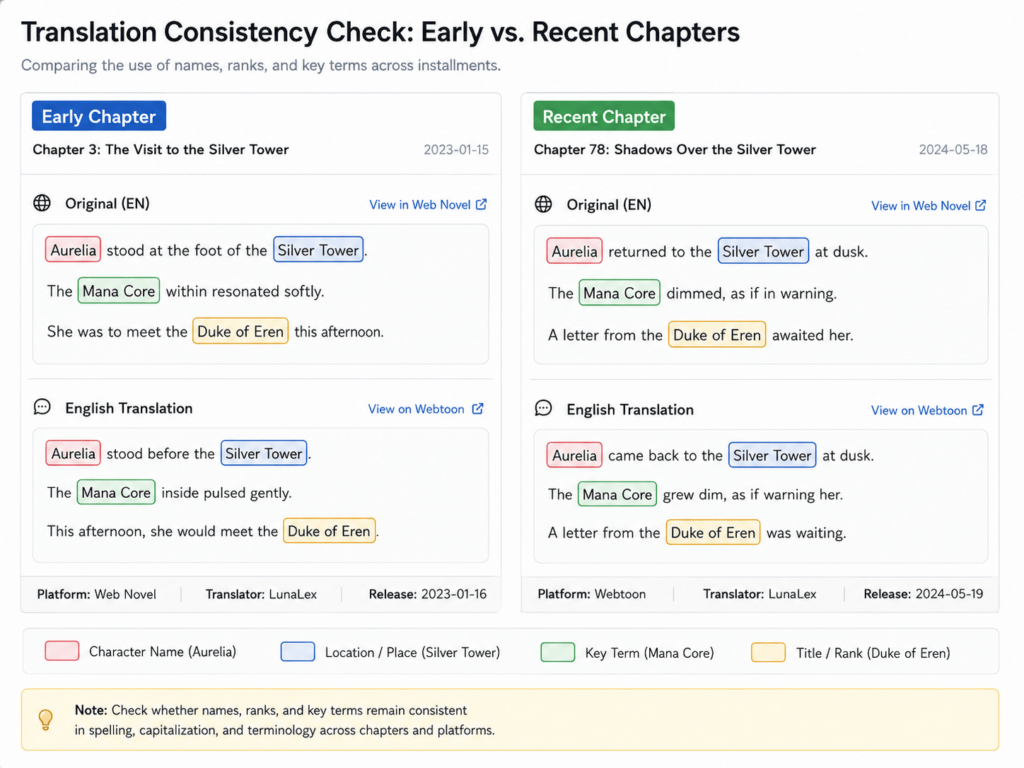
Start with a free early installment and compare it with a recent chapter or episode from the same series. The goal is not only to identify obvious grammar mistakes. Check whether character voices remain stable, names and titles are written consistently, and recurring terms retain the same meaning throughout the story.
This is especially important in fantasy, historical romance, martial arts, regression, and game-system stories. A change in the translation of a rank, family title, magical skill, item, or political position can make later chapters difficult to understand.
Dialogue should also match the relationship between the characters. A grammatically correct sentence can still feel inaccurate when it removes differences in age, status, intimacy, or formality. Humor, emotional tension, and culturally specific expressions may also become flat when translated too literally.
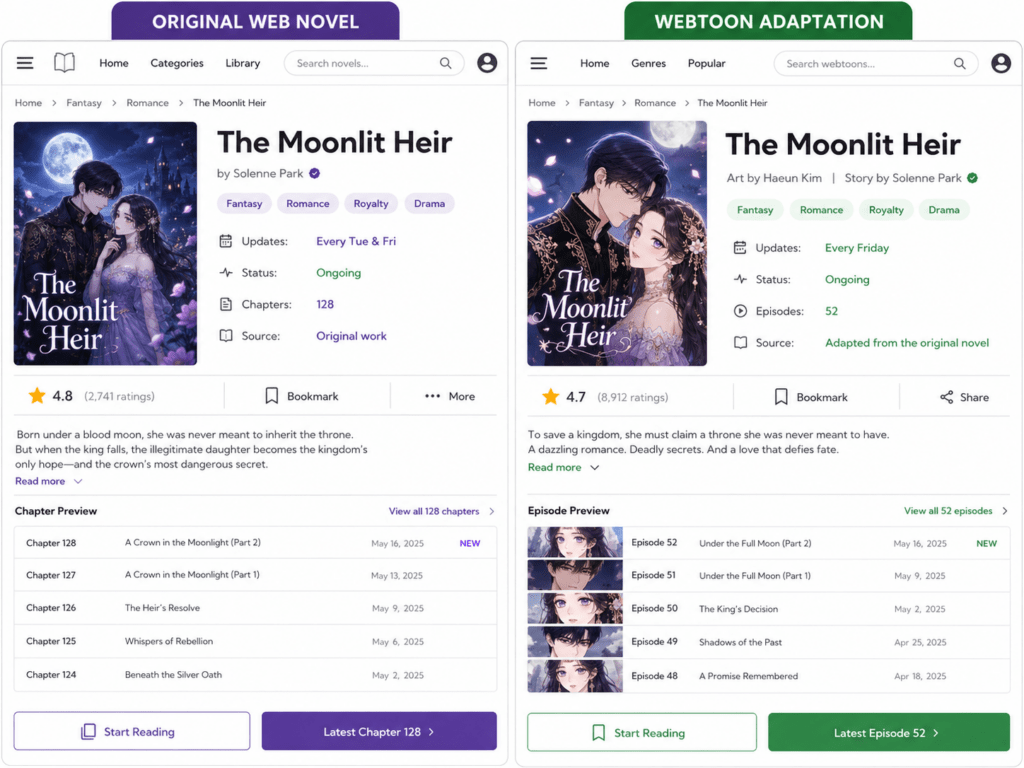
When the same Korean story is available as both a web novel and a webtoon, compare one corresponding scene. Tappytoon, for example, identifies some comics as adaptations and links readers to the original novel, including titles such as My Life as an Internet Novel and The Reason Why Raeliana Ended Up at the Duke’s Mansion.
However, differences between the two versions do not always indicate a translation problem. A webtoon adaptation may shorten internal narration, reorder scenes, simplify explanations, or change dialogue to fit the visual format. The reader should separate these adaptation choices from inconsistent terminology or unnatural English.
A practical translation check should cover four points:
| What to check | Warning sign |
|---|---|
| Character names and titles | Different spellings or forms appear later |
| Recurring terminology | Ranks, skills, or locations change without explanation |
| Character voice | Different characters begin to sound identical |
| Sentence flow | The meaning is understandable but reading feels unnatural |
Official licensing confirms that a platform has permission to distribute the work, but it does not guarantee that every series will provide the same localization experience. Read several installments before paying to unlock a long series.
Measure Release Reliability, Not Just Release Speed
A platform may advertise daily, twice-weekly, or weekly updates, but the more important issue is whether the series actually follows that schedule.
WEBTOON series pages commonly display a fixed release label such as “Every Tuesday,” while Tappytoon title pages can show release days such as “Every Thu” or “Every Fri.” These labels help readers understand the planned schedule, but the dates of recent episodes should still be checked.
Review the most recent eight to twelve installments and compare their publication dates. This reveals whether the series usually arrives on schedule or has repeated gaps.
A slower weekly release may offer a better experience than a series that promises frequent chapters but stops without a clear notice. Readers should also distinguish among different types of interruptions. A season break may be planned after the completion of a story arc. A creator hiatus may affect the original Korean version, while a localization delay affects only the translated release.
The number of chapters released each week should therefore be considered together with reliability.
| Release pattern | What it means for the reader |
| One chapter every week with few interruptions | Predictable and easy to follow |
| Several chapters each week | Faster reading, but consistency should be checked |
| Bulk release followed by long gaps | Better for occasional reading than regular following |
| Completed series | No waiting, but total unlocking cost may be higher |
| Hiatus without a return date | Consider waiting before paying for more chapters |
The distance between the translated edition and the Korean edition can also matter. A platform may release reliably while remaining many chapters behind the original. Only mention this gap when dates from both official versions can be verified.
Do not assume that a delay means the translation team is performing poorly. Licensing, production, creator health, content review, or coordination with the Korean publisher may affect the schedule. Unless the platform provides a reason, describe the interruption only as a verified gap.
Compare the Useful Catalog, Not the Largest Catalog
Catalog size should be measured according to the reader’s interests and preferred format.
WEBTOON describes its service as offering thousands of stories across 23 genres. Tappytoon officially provides both comics and novels, while Manta currently carries comics, novels, and manga. These descriptions show that each service offers a broad selection, but their totals cannot be compared directly unless all platforms use the same definitions.
One platform may count comics, novels, manga, completed titles, ongoing series, and short works together. Another may publish only a general statement about its catalog. A large total also does not show how many works are available in the reader’s language, genre, age category, or preferred completion status.
Create a personal catalog test instead. List 10 to 15 titles or story types you genuinely want to read, then search each platform using the same criteria.
For example, the list could include romance fantasy, action, dungeon stories, historical drama, BL, regression, completed series, and stories available in both novel and comic form. Record whether each result is an exact title, a similar recommendation, or unavailable.
| Personal catalog check | Platform A | Platform B |
| Exact wanted titles found | X/10 | X/10 |
| Preferred genres represented well | Yes/No | Yes/No |
| Completed series available | Verify | Verify |
| Both novel and comic available | Verify | Verify |
| Ongoing titles with reliable schedules | X titles | X titles |
The adaptation connection can be particularly useful. A platform carrying both the source novel and webtoon allows readers to choose between detailed narration and visual storytelling without changing services. Tappytoon explicitly links certain comics to their original novels, while Manta organizes novel-based comics and provides a dedicated novel selection.
Readers who prefer visual pacing and short weekly sessions may favor webtoon-heavy services. Those who enjoy internal narration, detailed world-building, and reading several chapters at once may receive more value from a stronger novel catalog. A reader interested in one specific Korean series may find the best value on the platform that carries both versions, even if its total catalog is smaller.
The final choice should not be based on a universal platform ranking. Choose the service that provides a readable and consistent translation, follows a schedule you can rely on, and carries enough titles in the formats and genres you actually enjoy.
A smaller catalog filled with relevant stories can offer better value than a much larger library containing little you want to read. Likewise, fast releases are not useful when the translation becomes difficult to follow. Test the actual titles first, and compare the platform only after confirming the reading experience.